Wednesday, March 30, 2022

Thinking about exorcisms

Disclaimer that I'm mostly basing this off of some conversations I once had with Father Peter, the Catholic priest on campus. So, also keep in mind this comes from a Catholic perspective.

I always find myself close to laughing when watching movies like The Possession, especially during the exorcism scene where everything is absolute chaos and flying around and everyone is screaming. It makes me wonder, is that actually what an exorcism looks like? Probably not. 

My friends and I were able to have a couple of interesting conversations with Father Peter last year since he has conducted a few minor exorcisms during his time as a priest. He cleared up a few things for us, the most pressing idea being that no, exorcisms are not as insane as people make them out to be in movies. My biggest concern during the conversation was if any person was susceptible to demonic possession, if, according to Father Peter, demonic possessions are real. He responded by saying that no, not just any person can be possessed. In a way, the person has to allow the possession to happen; they have to be so lost and so far wandering that they let the demon in. 

I don't know if The Possession was hoping to make a somewhat accurate depiction of demonic possession and the subsequent exorcism. But, in my opinion, it isn't accurate. It makes no sense why Em would be possessed following this logic; even if she might "allow" the dybbuk to possess her, she wasn't lost or wandering or in a dark state of mind. She wasn't in a situation that would allow her to be more vulnerable than she would be naturally. She was very content and happy with her life and the people around her. 

Of course, I could be a little off base right now since this should probably be looked at from the perspective of Judaism rather than Catholicism. Just some thoughts about exorcisms.
Monday, March 21, 2022

The Loss of teeth in : The Possession

 We all know the Scene where Em makes Brett's teeth fall out. Nasty Stuff! But what about the symbolism behind that? Teeth falling out usually symbolizes loss of control or  emotional disturbances you are  going through as you or your environment is going through change. This scene immediately followed by Brett leaving and not returning can be a symbol of him not accepting the new Em or even the fact of Em not liking him (referencing the garage scene).

Thursday, March 10, 2022

The Real Evil Lurking Within: Tokenization, Exotification, and Racism in the Subtext of 'The Possession (2012)'

Taken at face value, The Possession (2012) is a classic example of a Hollywood horror film, as it hits a fair number of tropes in the possession subcategory; an otherwise 'ordinary' white nuclear family left to grapple with the sudden, uncharacteristic, and dangerous change in one of their children (usually, it is the benevolent, gentle, and endearing white daughter). 

    The film depicts spiritual/metaphysical elements of a non-WASP (White Anglo-Saxon Protestant) culture and portrays these elements in a manner which seeks to exotify or sensationalize. Yes, the dibbuk box was of Jewish origin, so including parts of Jewish tradition in the narrative was necessary to make this film both plausible and believable. However, it may be worthwhile to consider:

    1) Why was a dibbuk box in particular chosen to be the main conduit for horror in this film? 

    2) Why was Judaism discussed or portrayed only in relation to the demonic circumstances at hand? 

    3) Why was Apyzou's dialogue transcribed in the subtitles as [unintelligible whispering], rather than a direct translation? If it was the film's intention to leave these words purposefully obscured, why? 

    4) Why did Clyde (the dad) need to seek help from the Hasidic community in particular -- a branch of orthodox Judaism viewed by western goyim as "traditional" or, less kindly, "other," or even "backwards"? 

    5) Why couldn't Clyde's family have been Jewish? Why couldn't it have been a demon from a Christian tradition? Would either of these alterations change how 'scary' this film is? Why? 

    All of these are questions alluding to the main issue with not only the writing and execution, but the very concept of the film itself: the exotification and subsequent (literal) demonization of Judaism & its portrayal as, at best, a strange, foreign, yet ultimately benign and subservient token minority (as symbolized by Tzadok), or at worst, a danger that can be tracked into your home and influence your children in ways that you are unable to comprehend or control (as symbolized by Abyzou). The irony of this dichotomy is that it isn't a dichotomy at all; both Tzadok and Abyzou are Jewish, both are used as tools to strengthen the bond of the white nuclear family, solidifying their connection to each other whilst simultaneously drawing clear cut lines between what should be viewed as normal, safe, or right (the white nuclear family reunited as one), and what is abnormal, unfamiliar, or 'other' (Judaism). Tzadok is not even thanked for risking his life to exorcize Abyzou. And then he is killed rather unceremoniously. In the final shots of the film, we do not see Tzadok's corpse, or even a stray lamb dangling out of his totaled car; the first and last on-screen depictions of Jewishness in The Possession are an evil, child-killing demon. 

Also interesting to note are the only depictions of black people in The Possession being 1) basketball players, and 2) a school teacher, who is the first character to die. It seems that this film hit all the best classic Hollywood horror tropes. 


Monday, February 28, 2022

Monster by Kanye West

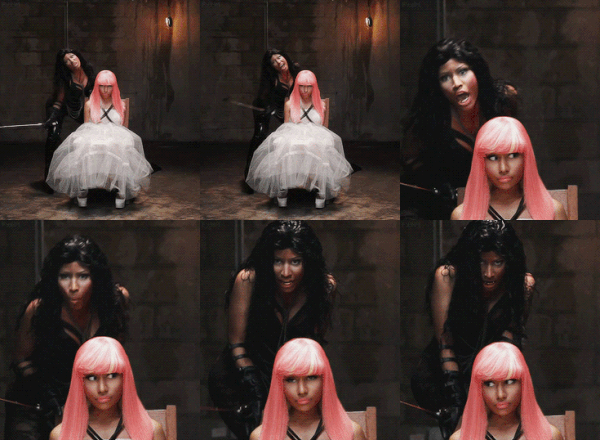
As some may know, I love the music (with particular emphasis on music) of Kayne West. When you have a song that involves both Kayne West and Nicki Minaj, it is GAME OVER for me. I have been a long-time listener of the song "Monster" and especially Nicki's verse... which is near perfection. I was thrilled when we listened to the song in context with this course. I had never seen the video, but I was unsurprised about its provocative (and that is debatable in itself) and disturbing imagery. But, knowing the controversy surrounding Kanye West always, the watching of the music video piqued my interest in the public reception of the content. 

Nicki minaj monster GIFs - Get the best gif on GIFER

The whole idea of the monster is that it is more than what it stands to be. It is oftentimes something grotesque, disturbing, and provocative, but it is intentional because it serves as this "conceptual arena" for culture to battle out these binaries of what is right/wrong, good/evil, etc. What is exactly provocative about the video, the use of dead (especially white) women? I think that the uncomfortably, and maybe even disgust, that we feel about the use of this imagery should be used to further understand who the "monster" is in this video and what cultural narratives we use to perpetual the fear surrounding this monster. Maybe it's not to video that is so disturbing, but the monsters that we have allowed to be created. 

Regardless of my opinion, there is a great article online that furthers the discussion about the song and the video and I hope you give it a read! 

https://www.its-her-factory.com/2011/01/what-everybody-doesnt-seem-to-know-about-kanye-wests-monster/

here is another fun link, which ranks who has the best verse on the song :)

also, if you wanna know how she wrote the verse, click here

Tuesday, February 22, 2022

How did Tiamat become a Dragon?

The Enūma Eliš, as we've seen, is a foundational myth in Mesopotamian culture. Tiamat as a central character fills the role as the mythical mother of gods and monsters, an avenging wife, and a monster herself, as tempestuous as the seas which she represents. While there isn't much scholarly debate over what Tiamat actually is (as a goddess and a creature representing saltwater), when you get into the specifics of what she looks like, things get a bit more muddy. 
We do not have any truly "original" depictions of Tiamat from when the Enūma Eliš was written or even from Mesopotamia (the images we do have are below and were found to be from around the same time during the Neo-Assyrian Empire), and the Enūma Eliš itself is loose on specific details outside of the generic inclusion of things like “a head” and “entrails” in her description. But later depictions show her as a serpent or a "dragon," alternative translations even calling her such. 
Here's one where she has many different animals 
making her up, like a lion, an eagle, horns, and snake parts.
A relief from the palace of Ashurbanipal from the 860 BCE

This depiction is believed to be a seal showing the defeat of 
Tiamat, and will be the image I focus on the most (she's the long one)

Dragons, though, are ill-defined. What a dragon is can be different depending on what time and in what culture you ask the question. Early Jewish apocalypse tales featured Behemoth and Leviathan, monstrous beings of primordial chaos like Tiamat that opposed YHWH and could have very well been called draconic. The Greek drakon (one who looks/stares) was a large, serpent-like creature that guarded different things, like the Drakon Ismenios, which guarded a sacred spring of Ares near Thebes. This idea of a dragon was later subsumed into Old English culture, where dragons (draca), described as wyrms or serpents, hoarded treasure and would fight heroes to defend it, like is seen in the dragon that slew Beowulf with its venomous bite. But if you look further east, dragons were water spirits in most of East and Southeast Asian myth, and were highly intelligent, shapeshifting, snake-like beings that controlled the rain.
Check the snakeyness on this Ismenios bad boy!

Pictures taken moments before disaster (ft. Beowulf)

A long lad from the Qing Dynasty
All this to say that the only unifying factor between all these mythic dragons is being vaguely snakey, and even that was a stretch with some of the other animals thrown into Mesopotamian “dragons” like lions or eagles. What we would consider now as a Western dragon (or as I once heard it, a dinosaur with wings) didn’t appear until 1260 C.E. in the medieval bestiary, MS Harley 3224.
The original Western Winged Dragon
in the MS Harley 3224 bestiary
An interesting thing, though, is how Tiamat has been repurposed by modern Western culture, where we have re-applied our modern definitions of a dragon to her early depictions and characterization. If we look at how Tiamat was originally thought of, she was destructive and chaotic, but not evil. She was a mother and suffered the tragic deaths of her first and second husband, and was driven to destruction because of that loss and grief. She is Marduk’s adversary, but she is also his grandmother, and through her defeat, she created the rest of the world: the land and sky from the two halves of her body, the Tigris and Euphrates from her tears, the mountains from her breasts, etc. Tiamat is a swirling mass of destruction and creation, and is more complicated than good or evil. 
Some of the Enūma Eliš tablets!

Now, though, you’d be hard pressed to find a depiction of Tiamat that isn’t evil. The most prominent example is from the original tabletop roleplaying game: Dungeons and Dragons. Tiamat, in this mythology, is a 5-headed chromatic (aka, evil) dragon hell-bent on destroying her brother, Bahamut (derived from the biblical Behemoth mentioned earlier), who she helped create the world with. Bahamut is the leader/creator of the metallic (good) dragons, and Tiamat and her children, the chromatic dragons, will stop at nothing until all his creations are gone from the Earth. The most succinct way I think she can be described in this form is as “arrogant, greedy, hateful, spiteful and vain,” as she's described in the supplemental D&D book, Faiths and Pantheons (2002). While this Tiamat retains a history of having helped create the world and even has the meta bonus of leading to the creation of modern dragons, her enduring legacy is that of an evil, malicious figure with little to none of the traits that makes the Mesopotamian Tiamat complex and interesting as a cultural and religious figure. 
D&D's version of Tiamat...she's definitely had a makeover

The wide reach of D&D on the modern fantasy landscape has led to other Tiamat depictions, some close to this reimagining, others departing to make her a breasty anime girl who can shoot lasers out of her hands. But each version clings very closely to the idea that the original Tiamat was a dragon like we think of them in the West today, wings and all. It’s my belief that even if Tiamat was the mother of the modern-day dragon, she and her original depictions should not be forgotten. She should be remembered in all her snakey, weird metaphorical glory, vague descriptions and all.
And if Mesopotamian myth is to be believed, this is Tiamat's world, and we're just living on it. Maybe it's best not to upset her by messing with her look.
And now, here's some examples of modern Tiamats that I had to look at while trying to find images for this blog post! Now you have to look at them too :)
I'll give it points for including the feathers,
feet, and saltwater epithet, but what on Earth 
is going on with the head...


What in the... Ya know, 0 points. 
-20 points. 
-1000 points. 
I do not like it.


They turned her into a Funko Pop. This is a dark day.

I'm actually ok with this one. At least they got the ocean 
in there, that's honestly good enough for me at this point.


Thanks for reading!


Also, here's an aside to talk about Satan for a sec:

If Europeans took the ideas of big snakes and turned them into dragons, and Satan’s first appearance in the Bible was as the serpent that tricked Adam and Eve into consuming the fruit from the tree of knowledge of good and evil, why hasn’t Satan taken the form of a dragon in the wider Christian mythos today? Sure the Middle Ages had depictions of him as a draconic-ish creature at times, but I want a Game of Thrones style dragon Satan to have his own story. Give me the Paradise Lost cultural fanfic that canonizes Dragon Satan. I’ll be waiting.


Sources

https://en.wikipedia.org/wiki/Tiamat


https://www.brooklynmuseum.org/eascfa/dinner_party/heritage_floor/tiamat#:~:text=Tiamat%2C%20a%20Babylonian%20personification%20of,split%20her%20body%20in%20half.


https://forgottenrealms.fandom.com/wiki/Tiamat


https://en.wikipedia.org/wiki/European_dragon#:~:text=MS%20Harley%203244%2C%20a%20medieval,a%20fully%20modern%2C%20western%20dragon.


https://www.theoi.com/Ther/DrakonIsmenios.html#:~:text=THE%20DRAKON%20ISMENIOS%20(Ismenian%20dragon,monster%20with%20a%20heavy%20stone.


https://en.wikipedia.org/wiki/The_dragon_(Beowulf)#:~:text=The%20Beowulf%20dragon%20is%20described,vengeful%2C%20fire%2Dbreathing%20creature.


https://www.youtube.com/watch?v=3eXAPwjASEQ


http://oracc.museum.upenn.edu/amgg/listofdeities/tiamat/index.html#:~:text=Tiamat%20is%20a%20personification%20of,in%20the%20En%C5%ABma%20Eli%C5%A1%20TT%20.


Enuma Elish


https://www.ancient-origins.net/myths-legends-asia/tiamat-mesopotamia-0010565


Monday, February 21, 2022

Why do we give demons so much credibility?

This might be just a lot of me rambling about what I thought about the Björklund reading. 

There are a lot of deeply religious people throughout the world, but right now I'm focusing specifically on the United States. Thanks to social media, we are able to (unfortunately?) keep up on a lot of what those deeply religious people have to say about society and life as a whole. They use the Bible to justify their beliefs, they use demons and Satan to explain why the world isn't the way they want it to be. My question is, why do so many Americans give demons so much credibility?

The Björklund reading concludes by saying, "The child-killing demons can be seen in the context of a scapegoat. They shouldered the blame for miscarriage or death of a child, relieving the members of the community of guilt" (44). "Demons" were a very convenient way to explain why something really awful happened, and it then provided comfort to people knowing that a) there is an explanation, and b) it wasn't any person's fault. It was completely out of their hands. I feel like we as a society in the United States have far moved past the idea that we need to blame anything that goes wrong on Satan or on demons. Especially because of the knowledge we now have: demons in ancient times weren't really thought of as evil, and belief in evil demons was really just used as a scapegoat or explanation. 

I just can't understand the widespread Christian belief I see in America that really distorts what history in the Global South or in ancient Europe had to say about demons. I hope we'll explore more in this class about how this history became so warped.

Monday, February 14, 2022

Is Leviathan a descendant of Tiamat?

Like all good questions in life, the answer is yes and no! While both the story of Leviathan and the defeat of Tiamat by Marduk contain many obvious parallels, they likely do not share a common origin or source and are, instead, distant cousins that reflect the broader Mesopotamian world. The existence of one water-based monster story in Babylonia in second millennium BCE does not indicate that there must be a connection to the other, famous water-based monster story in ancient Israel. This position, that all Mesopotamian and Near Eastern cultures were derivatives of Babylonian culture, is called Panbabylonianism. 

Rather than a true school of thought, Panbabylonism was a series of related movements that began in Germany around the middle of the nineteenth century with the discovery of Babylonian tablets. Immediately, scholars attempted to find similarities between ancient Babylonian texts and the Old Testament. German Assyriologist Friedrich Delitzsch argued that Babylonia was the starting point of European culture and that all Israelite traditions were directly dependent on Babylonian traditions. He pointed, particularly, to the Genesis Creation Myth and the Flood Myth and compared them to the Epic of Gilgamesh and the Ennuma Elish. In his lecture "Bible und Babel" (Bible and Babel), he connects the word Tiamat to the Hebrew word tehom, the primordial chaos from which the heavens and the earth are created (sometimes translated as "the Deep.")  He further finds "an echo of [the] contest between Marduk and Tiamat in the Apocalypse of John, where we read of a conflict between the Archangel Michael and the ‘Beast of the Abyss, the Old Servant, which is the Devil and Satan'" (Delitzsch 45).

Friedrich Delitzsch, German Assyriologist and Professional Antisemite

Unsurprisingly for the turn of the century Germany, these ideas were built on top of a sinister undercurrent of Antisemitism. This was not merely a dry, academic debate about the diffusion of Babylonian culture in the Ancient Near East, but one part of the larger social upheavals which were sweeping through Europe at the time (the aforementioned lecture was attended by Kaiser Wilhelm II himself!). Delitzsch broadly sought to discredit Semetic cultures as mere copiers and corrupters of a pure, Aryan Babylonian culture. 

In the end, Panbabylonism was thoroughly discredited and acts as a mere historical footnote in the study of Mesopotamia. Further investigation has found the Ugaritic Ba'al cycle, which describes a sea monster named Lôtān who is defeated by the storm/rain god Hadad. The current scholarly consensus is that Leviathan from the Old Testament is much more likely to be a direct continuation of Lôtān and related ancient Semitic serpent deities rather than Tiamat or anything else in the far older Babylonian mythology. 

So yes, we should be careful to make broad generalizations about the past to avoid sliding down the Bad History to Antisemitic Conspiracy Pipeline.

"The Destruction of Leviathan" by Gustav Doré 

Sources:

http://members.westnet.com.au/gary-david-thompson/page9e.html

https://www.britannica.com/topic/Leviathan-Middle-Eastern-mythology

https://theopolisinstitute.com/leithart_post/de-assyrianization/

https://www.google.com/books/edition/Babel_and_Bible/5RgYAAAAYAAJ?hl=en&gbpv=1&printsec=frontcover - Full Text of Babel und Bible 

Thinking about exorcisms

Disclaimer that I'm mostly basing this off of some conversations I once had with Father Peter, the Catholic priest on campus. So, also k...